 |
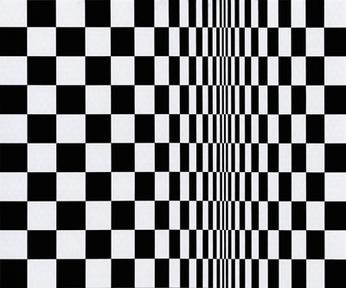
| http://upload.wikimedia.org/wikipedia/en/1/1b/Riley,_Movement_in_Squares.jpg |
Meaning:- Art that stimulates the eyes to see things or pictures in different ways. Based on Wikipedia, "perceptual art may be interpreted as the engagement of multi sensory experimental stimuli combined with the multiplicity of the interpretive meanings on the part of the observer. Sometimes, the role of the observer is obscured as members of the public may unwittingly or unknowingly be participants in the creation of the artwork itself."
Examples:- Op art is mainly a form of perceptual art. It is optical illusion art. "Optical art is a method of painting concerning the interaction between illusion and picture plane, between understanding and seeing." – John Lancaster. Op art is art that gives a viewer an impression of movement, hidden images, flashing, vibrations, pattern or warping.
- Bridget Riley (1961) – Movement of Squares
- Victor Vasarely (1965) – Optical Illusion.
- Richard Anuszkiewicz (1965) – Intrinsic Harmony.
- John McHale
- Reginald H. Neal
 |
| An optical illusion by Hungarian-born artist Victor Vasarely |
Basically, perceptual art is different from conceptual art as it stimulates the eyes of the observer. These artworks can cause the observer to see things moving, flashing, fading in and out, or even see things that are not meant to be seen. So when an observer sees a perceptual artwork, one person might not see the same thing that another person sees. In that sense, the observer becomes part of the artwork. Optical illusion art is fun to see because it's like a puzzle and you have to try your best to find all the hidden clues in the picture to see what the artist saw.
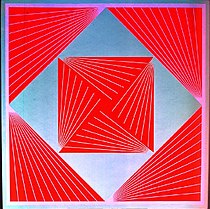 |
| Intrinsic Harmony, by Richard Anuszkiewicz, 1965 |

No comments:
Post a Comment