Meaning:- Art where the concept or ideas in the work is more important than the outcome. "In conceptual art, the idea or concept is the most important aspect of the work. When an artist uses a conceptual form of art, it means that all of the planning and decisions are made beforehand and the execution is a perfunctory affair. The idea becomes a machine that makes the art." – Sol LeWitt.
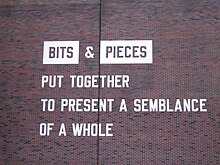 |
| Lawrence Weiner. Bits & Pieces Put Together to Present a Semblance of a Whole, The Walker Art Center, Minneapolis, 2005. |
Examples:-
- Robert Rauschenberg – Erased de Kooning Drawing by Willem De Kooning (1953)
- Yves Klein – Aerostatic Sculpture (Paris 1957), 1001 blue balloons released into the sky.
- Christo's Iron Curtain work (1962), consists of a barricade of oil barrels in a narrow Paris street which caused a traffic jam. The artwork was the large traffic jam.
- Joseph Kosuth – One and Three Chairs (1965), picture above, consists of a chair, its photo and a blow up of a definition of the word 'chair'. Kosuth had chosen the definition from a dictionary, 4 versions with different definitions are known.
 |
| Joseph Kosuth, One and Three Chairs(1965) |
Basically, conceptual art requires doing research and some serious thinking and planning on how to create the artwork and what each stroke would represent. A person that's viewing a conceptual art will be stimulated in the brain to think about the meaning of the artwork. To truly appreciate the artwork, a person must be able to see past the picture into its deeper meaning. Even an empty canvas can provide a deeper meaning to someone that another person might not be able to comprehend.
 |
| Jacek Tylicki, Stone sculpture, "Give If You Can - Take If You Have To". Palolem Island, India, 2008 |

No comments:
Post a Comment